Two out of three Google searches now end without a click
68% of Google searches ended without a click in early 2026. For a small Indian shop that is less of a catastrophe than it sounds — but a real warning.
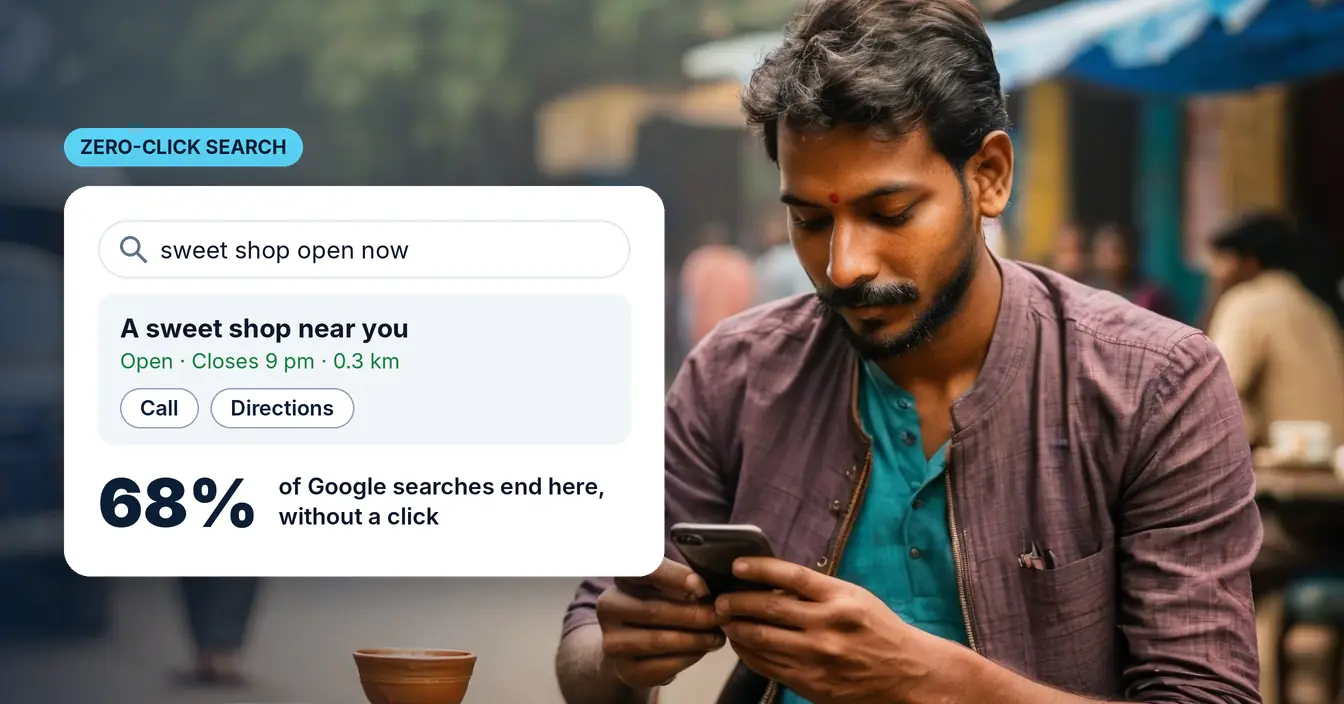
A customer wants to know if you are open on Sunday.
Two years ago they typed your shop's name into Google, saw a blue link, tapped it, landed on your website, and read your hours. You saw a visitor. Maybe they browsed. Maybe they called.
Today they type the same thing, read the answer directly on the results page — or from an assistant that never showed them a results page at all — and get on with their day. They got what they needed. You never knew they existed.
Multiply that by every customer who ever wanted your address, your price, your phone number, or whether you had a thing in stock.
The number
A hundred people search. Sixty-eight never click anything.
68.01% of Google searches ended without a click in January–April 2026, up from 60.45% in 2024 — SparkToro and Datos, from Similarweb clickstream data. That panel is United States desktop and mobile-browser traffic, not India, and not the Google app. Nobody has published the equivalent Indian figure. Treat it as the direction of travel, not as your number.
That is the fastest two-year jump in a decade of this being measured. Not a drift. A step change.
And I want to be straight about the limits of it before anyone builds a strategy on it, because most of the posts you will read about this figure will not be: that study is a United States panel. Desktop and mobile-browser traffic, not the Google app, not India. Nobody has published a comparable Indian number. India's mix is different in ways that probably matter — far more app usage, far more voice, far more searching in a second language.
So take it as the direction the ground is moving, not as a measurement of your street. Anyone who quotes you 68% as an Indian statistic either has not read the study or is hoping you will not.
Why this is not the disaster it sounds like
Here is the part that gets left out, and it is the part that matters most if you run a shop rather than a publisher.
A zero-click search is not a lost customer. It is a customer who got served without touching your website.
When someone searches your shop's hours and Google answers directly, where did Google get that answer? Your Google Business Profile. When someone asks an assistant for the best three places nearby that sell what you sell, what is it reading? Listings, reviews, and whatever it can find written down about you in plain language.
For a news website, zero-click is genuinely brutal — the click was the business. For a shop in Salt Lake, the click was only ever a middle step. What you wanted was the visit, the call, the WhatsApp message. If the customer can get your address without loading your homepage, and then walks in, you have lost a pageview and kept the customer.
The businesses being hurt here are the ones whose entire online presence was a website. The businesses doing fine are the ones whose details are correct, complete and consistent in the places the machines actually read.
Now the part that should worry you
If a search engine or an assistant cannot find good information about you, it does not go quiet. It answers anyway.
It will say you are permanently closed, because a listing said so eighteen months ago. It will give an old phone number. It will confidently recommend three competitors and not mention you. It will state a price you have not charged since last year.
And here is the genuinely new problem: there is no click for you to correct it on. In the old model, a wrong result still sent someone to your site, where they could see for themselves. Now the wrong answer is the whole interaction. The customer never arrives, and you never find out.
Do not take my word for any of this. Go and ask.
Ask an assistant about your own shop.
Type your business name. This writes the questions a customer would actually ask, and you go and see what comes back. Nothing is sent anywhere from here — the text is built in your browser.
What do you know about my business in Kolkata? Are they still open?
I want to contact my business in Kolkata. What are their opening hours, phone number and address?
Recommend three good options in Kolkata for what my business sells, and say roughly what each charges.
There is no right score here and this does not grade you. If the answer is confident and correct, your details are consistent enough for a machine to trust them. If it is vague, out of date, or about somebody else — that is what a customer is being told right now, and there is no click for you to fix it on.
Most people who run this on their own business get a mild shock. That is the honest state of things, and it is fixable.
What actually makes a business quotable
There is a lot of nonsense being sold about this right now under names like AEO and GEO, mostly by people repackaging what they were selling last year. The reality is duller and cheaper than the pitch.
A machine will repeat a fact about you when that fact is stated plainly, in one place, and agrees with everywhere else it appears. That is close to the whole of it. Five things follow from it.
Your Google Business Profile is now more important than your website. For a local business it is the single highest-value asset you own online, and it is free. Claimed, verified, correct category, correct hours, real photographs, questions answered. If you only fix one thing this year, fix this.
Your name, address and phone number must match exactly, everywhere. Google, Facebook, your website, IndiaMART, JustDial. Not "roughly the same" — the same. "Sharma Electricals" and "Sharma Electrical Store" are two businesses as far as a machine is concerned, and a machine that is not sure which one you are will hedge, or pick someone it is sure about. This is the most common problem I find and the most boring to fix, which is presumably why nobody sells it.
Write down the things people actually ask. Your prices. Whether you deliver, and where. Whether you do repairs. What you do not do. A page that answers a real question in plain sentences can be quoted. A page of adjectives about your commitment to excellence cannot, because there is nothing in it to quote.
Publish your prices if you honestly can. This is the uncomfortable one, and it is the single biggest gap in this market. When somebody asks an assistant what something costs in Kolkata, it can only answer from sources that said a number. Almost every agency and service business in India answers "what does it cost" with "book a call". They have made themselves unquotable, and they did it to themselves.
Structured data, then stop worrying about it. The machine-readable version of your facts — opening hours, address, prices, FAQ — is worth having and takes an afternoon. It is not magic and it will not rescue a business whose details are wrong. Get the facts right first, then mark them up.
What has stopped working
Keyword stuffing was already dead and is now dead twice. Writing "best electrician in Kolkata best electrician near me Kolkata electrician" into a footer does nothing except make the page worse to read.
Thin blog posts written to hit a word count are worse than nothing now. If a page has no fact in it that could be quoted, it will not be quoted, and it was only ever there to pad a monthly report.
Anything that depends on the customer landing on your website before they can learn anything about you. If your hours only exist behind a JavaScript accordion on a slow page, they effectively do not exist.
What I did on this site, in case it is useful
I would rather show the working than claim expertise, so: this site publishes its prices on the homepage, in plain sentences and in structured data, specifically so that an assistant asked "what does it cost to get a small business online in Kolkata" has a real number to quote instead of a demo-booking form. Every service has its own page with its own FAQ written as actual questions. There is a /llms.txt file, which is an emerging convention that may well amount to nothing — I have written as much on the file itself rather than pretending otherwise.
None of that is clever. It is just deciding to be legible.
The checklist
If you do these in order you will have done more than most of your competition:
- Claim and verify your Google Business Profile. Check it does not say permanently closed.
- Fix the category. "Website Designer" and "Marketing Agency" are different businesses to Google, and so are "Sweet Shop" and "Restaurant".
- Put ten real photographs on it. Not stock.
- Make your name, address and phone identical on every platform you are listed on. Write the four lines down once and copy them.
- Add your hours, including the days you are closed.
- Answer the five questions customers actually ask, in writing, in plain language, somewhere public.
- Publish a price, or a range, or at least a starting figure.
- Ask an assistant about your business again in a month and see whether the answer improved.
Number eight is the only measurement that matters now, and it costs nothing.
If you would like this checked rather than guessed at, the free scan runs the automatic half in under a minute — search visibility, speed, broken links, how your link looks when it is forwarded on WhatsApp — and I do the Google listing and the name-matching by hand and send it separately. You keep the findings whether or not you ever hire me, and sometimes the honest answer is that you have one cheap thing to fix and should not spend anything else. If that one thing is the listing, putting it right is what our Google Business Profile setup service in Kolkata does, as a one-off job.
Sources: SparkToro — In 2026, less than one third of Google searches still send a click, using Similarweb clickstream data for January–April 2026.
Written by Shyam Patra, who runs Orderzone from Kolkata. If something here is wrong or out of date, tell me and I will fix it — the date at the top changes when I do.