What automation actually looks like for a small business — six stories
No jargon. Six ordinary Kolkata businesses, the job that eats their day, and what their phone shows them once a bot or a small app does that job instead.
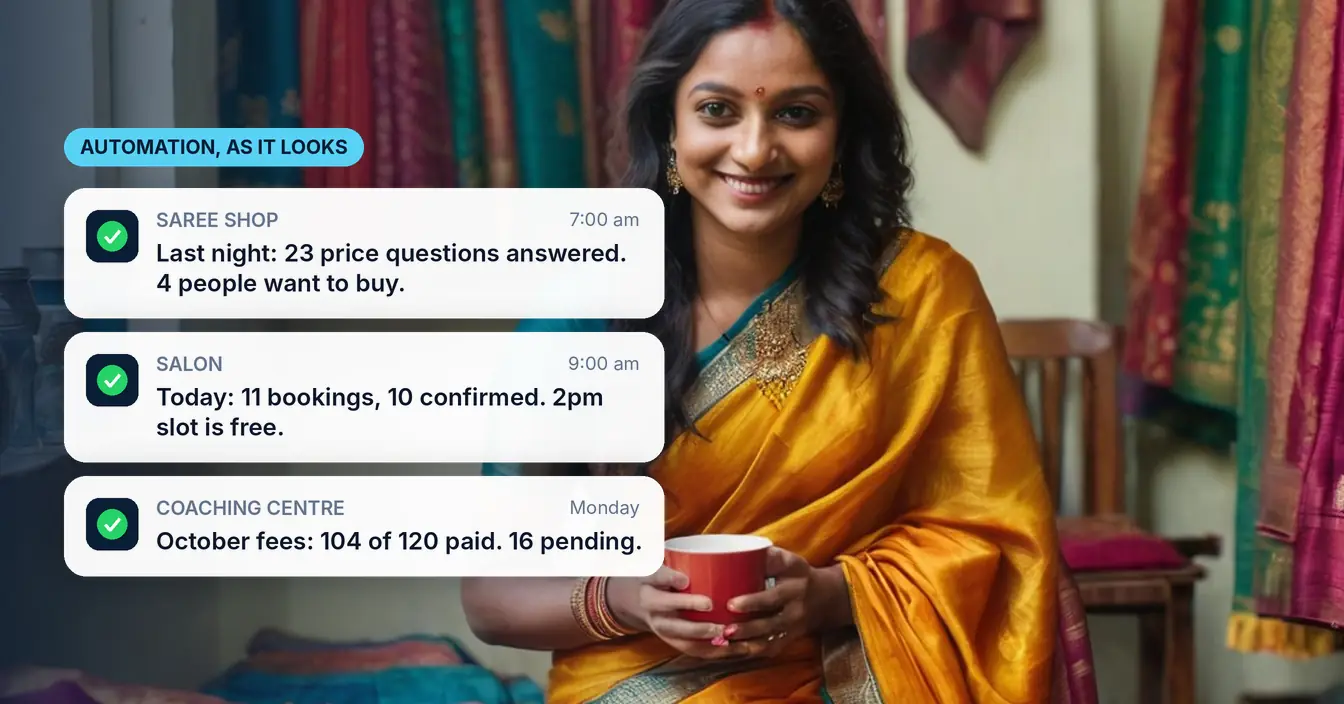
"Automation" is a word most shop owners have heard and almost nobody has been shown. Somebody says chatbot, API, workflow, AI agent, and the conversation ends there, because none of those words tell you what would be different tomorrow morning.
So this post does not explain any technology. It tells six short stories. Each one is a kind of business you will recognise, the one job that eats the owner's day, and what the owner's phone shows them once that job is done by a bot or a small app instead of by them.
These are illustrations of what we build, not client case studies — we are new to this and will not dress up an example as a testimonial. The numbers in the phone messages are made up to show what the summary looks like, not results anyone has achieved. When real client stories exist, they will be published with the owner's name and permission.
1. The saree shop that answers "price?" in its sleep
Before. Every evening the owner of a small saree shop in Gariahat sits with her phone for an hour. Forty WhatsApp messages, most of them a photo and one word: "price?" Some came in at 11pm. By the time she replies next morning, half of those people have bought somewhere else.
What we build. A WhatsApp assistant that knows her catalogue — every design, its price, colours in stock — and replies the moment someone asks, in English, Hindi or Bengali, whichever they wrote in. If someone wants to buy, it takes their name and address and hands the conversation to her.
What she sees. She wakes up to a short message: "Last night: 23 price questions answered. 4 people want to buy — tap to see them." She spends her hour on the four buyers, not the twenty-three questions.
2. The salon whose chair is never empty because someone forgot
Before. A three-chair salon in Jadavpur takes bookings over the phone and writes them in a register. People forget, the chair sits empty for an hour, and the owner only finds out when the slot has already gone.
What we build. A booking link customers can open from Google or Instagram, which shows only the free slots. The evening before, each customer gets a WhatsApp reminder with two buttons: Confirm or Change time.
What the owner sees. One message at 9am: "Today: 11 bookings, 10 confirmed, 1 moved to Thursday. 2pm slot is free." She posts the free slot as a WhatsApp status and it fills.
3. The coaching centre that stopped chasing fees by hand
Before. A coaching centre with 120 students. On the 5th of every month the owner's assistant goes down a notebook and phones parents about unpaid fees. It takes two days, and it is the job everybody hates.
What we build. A small app that holds the fee list. On the 1st it sends each parent a polite WhatsApp reminder with a UPI payment link. When a payment comes in, it is ticked off automatically. On the 7th, only the parents who still have not paid get a second reminder.
What the owner sees. A one-line summary every few days: "October fees: 104 of 120 paid. 16 pending — list attached." Nobody makes 120 phone calls.
4. The wholesaler whose orders stopped getting lost
Before. A Burrabazar wholesaler takes orders from shop owners all over Bengal — on WhatsApp, as voice notes, as photos of handwritten lists. His staff retype them into a book. Sometimes an order sits in a chat for a day before anyone notices.
What we build. A bot that reads every incoming order message, including photos of handwritten lists, and turns it into a clean row in a sheet: shop name, items, quantities. It replies to the buyer to confirm what it understood, so mistakes get caught by the person who placed the order.
What the owner sees. A live order sheet on his phone, and every evening: "Today: 31 orders, 3 need a check — the photo was unclear." His staff pack from the sheet instead of scrolling through chats.
5. The clinic that fixed its Google reviews without asking awkwardly
Before. A dental clinic has happy patients and only nine Google reviews. The doctor knows reviews matter. Asking each patient in person feels awkward, so it never happens.
What we build. Two hours after an appointment, the patient gets one WhatsApp message thanking them, with a direct link to the clinic's Google review page. No follow-up nagging, and nobody who complained gets the link.
What the owner sees. New reviews arriving on their own, and a monthly note: "October: 38 patients messaged, 9 new reviews."
6. The small kitchen whose owner gets a Sunday off
Before. A home kitchen in Behala sells lunch thalis to offices nearby. The owner takes every order herself on WhatsApp, adds up totals in her head, and copies the list for the delivery boy. She cannot step away from her phone between 10 and 1, any day.
What we build. A simple order page with that day's menu, linked from her WhatsApp status and Google listing. Orders land in one list with addresses and totals already worked out. The delivery boy gets his own route list on his phone.
What she sees. At 11:30 the order list closes and she gets: "Today: 27 thalis, ₹4,320, 3 unpaid — cash on delivery." She cooks. The phone does the counting.
What all six have in common
None of these owners learned a new piece of software. Every story is the same shape:
- One repetitive job that eats hours every week — replying, reminding, retyping, chasing.
- A bot or a small app that does that one job, inside WhatsApp or a link the customer already uses.
- A short summary on the owner's phone, so they only deal with the part that needs a human.
That is what we mean when we say automation. Not a robot running your business — just the boring part of one job, taken off your hands.
What it costs, honestly
Every project is quoted on its own, because it depends on how much volume you have. Two running costs get named before you agree to anything: WhatsApp's official business messaging is billed by Meta per message (our WhatsApp pricing post has the exact rates), and AI replies are metered by whichever AI provider powers them. Those are your bills, paid straight to them, not our margin.
And if the job you want automated only happens a few times a week, we will tell you it is not worth automating yet. A good first step is still the free scan on our homepage, which shows what your website and Google listing are missing today.
Written by Shyam Patra, who runs Orderzone from Kolkata. If something here is wrong or out of date, tell me and I will fix it — the date at the top changes when I do.