WhatsApp Business API pricing in India (2026)
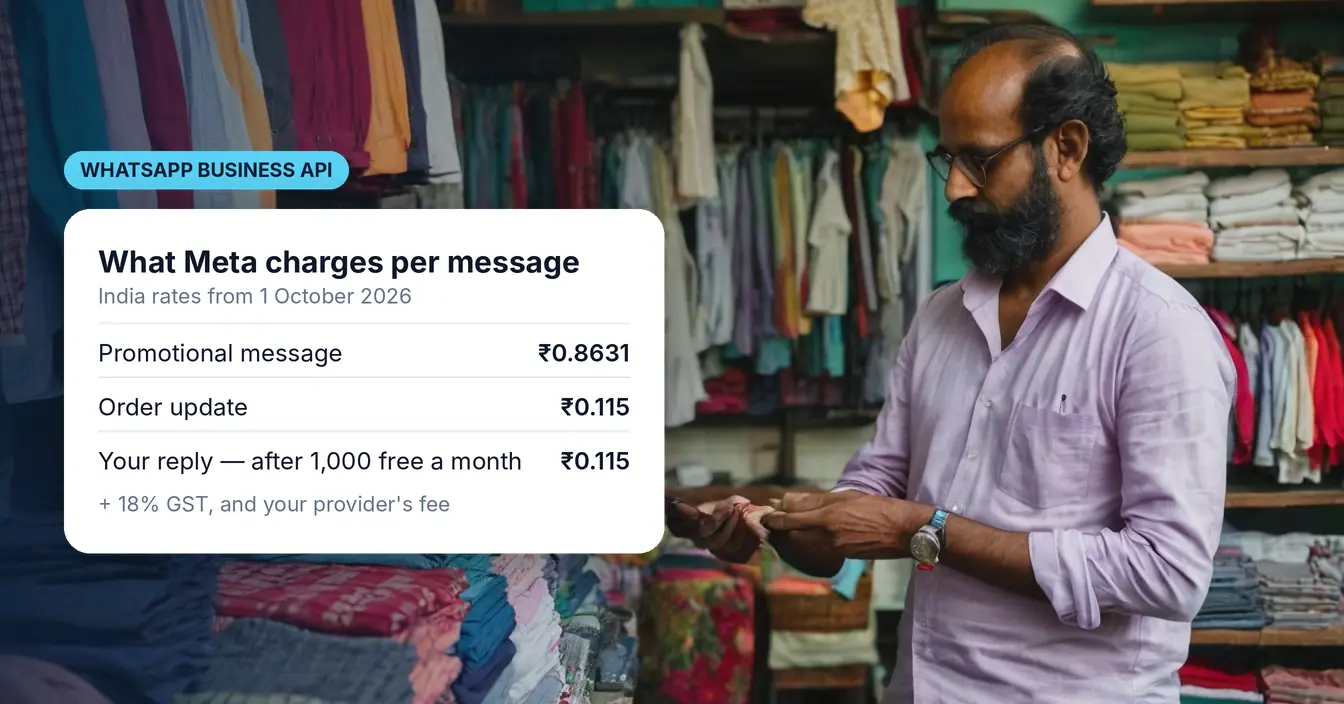
Meta's India rates: ₹0.8631 per marketing message, ₹0.115 utility, and from 1 Oct 2026 ₹0.115 per reply after 1,000 free a month — plus 18% GST and markups.
Updated 21 October 2026
Somebody will offer to set up "WhatsApp marketing" for your shop. The setup fee will sound reasonable. What almost nobody puts in writing is that Meta bills you separately, per message, every month, for as long as you keep sending — and since 1 October 2026 that bill can include the replies you type yourself.
Here is the whole price list, checked against Meta's own India rate card on 21 October 2026.
Meta's India rates, per delivered message
| What you send | Meta's rate | What counts |
|---|---|---|
| Marketing message | ₹0.8631 | Offers, new stock, festival pushes — anything promotional that you start |
| Utility message | ₹0.115 | Order confirmed, payment received, out for delivery, appointment tomorrow |
| Authentication message | ₹0.115 | OTPs and login codes (₹2.4971 if the number is outside India) |
| Your reply inside the 24-hour window | ₹0.115 | Anything you send to a customer who messaged you first. The first 1,000 a month per business number are free |
Meta charges only for messages that are delivered, and only for messages you send — what a customer sends you costs nothing. Everything in the table is before GST, which comes further down.
Marketing is the expensive category on purpose. Meta prices it at roughly seven and a half times the others, so the thing most "WhatsApp marketing" packages actually sell — broadcasts to people who did not ask for them — is the one with a real price on it.
What changed on 1 October 2026
Two things that used to be free are now billed.
- Your replies, after the first 1,000 a month. From 1 November 2024 to 30 September 2026, anything you sent to a customer within 24 hours of their last message was free. From 1 October 2026 Meta charges those messages at the utility rate — ₹0.115 in India — but the first 1,000 each month, per business phone number, stay free. The allowance resets on the 1st and unused messages do not carry over.
- Utility messages inside that same window. An order update sent while the customer's 24-hour window was open used to be free as well. It is now ₹0.115, like any other utility message. The free 1,000 does not cover these.
For most single shops, 1,000 free replies a month is the whole reply bill. Twenty enquiries a day, answered in two messages each, is about 1,200 replies — 200 over, or ₹23 before GST. Where the replies get expensive is a busy number with several staff on it, or a chatbot that answers in five short messages instead of one.
One condition matters: Meta's documentation says a business with no payment method on its account gets its 1,000 free replies and then has replies stopped for the rest of the month, not billed. Make sure your provider has a card or prepaid balance on file.
Meta's own AI agent is the exception to all of this. Replies written by "Meta Business Agent" are a separate category, billed at $2 per million tokens. Meta's own estimate is 4 to 5 US cents a message — a few rupees, roughly 30 to 40 times an ordinary ₹0.115 reply — and it is never free, not inside the 1,000 and not after an ad click.
What did not change: the 24-hour window still decides what you are allowed to send. Inside it you can type anything. Outside it you can only send a pre-approved template, and the template's category sets the price.
Who is paying whom
Meta publishes the rate. You almost never buy from Meta directly. You buy through a provider — the company whose dashboard you log into — and the number on their price list is the one you pay.
Some providers pass Meta's rate through unchanged and charge a separate platform fee. Others put a margin on the per-message rate and do not mention it. Both are legal. Only one of them is visible.
The gap is not small. In September 2026 one provider's public price list had marketing messages at ₹1.09 against Meta's ₹0.8631 — 26% over. In October another listed utility messages at ₹0.14 on its starter plan against Meta's ₹0.115 — 22% over. Neither page said "this includes our margin".
So the question to ask before signing anything is: what is your per-message rate for marketing and for utility, and how does it compare with Meta's? A provider who answers with two numbers is fine. A provider who answers "it depends" is on the second model.
And then 18% GST
Meta's rate is not what leaves your bank account. As an Indian business you pay 18% GST on top of it — and on the provider's platform fee too. On a small campaign it is a rounding error. On a list of a few thousand people, messaged weekly, it is real money, and I have never once seen it included in a quote.
Put your own list size in. It adds the GST and, since October, the replies:
What Meta will bill you for WhatsApp
Nothing you type here leaves your phone. There is no server behind this — the sums run in your browser.
Marketing messages are 15.0× your utility bill. Utility templates — order updates, delivery notices — cost a fraction as much and get read more, because people asked for them.
Default rates are Meta's published India per-message rates, checked 21 October 2026: marketing ₹0.8631 and utility ₹0.115 per delivered message, and since 1 October 2026 ₹0.115 for each reply you send inside the 24-hour window after the first 1,000 a month per business number, which Meta does not charge. Replies were free until 30 September 2026. The rates are editable above because rate cards change — Meta raised the India marketing rate about 10% from ₹0.7846. Your provider may add their own margin on top of these, and many do without saying so.
This calculator has its own page, if you want to send it to someone: WhatsApp Business API cost calculator for India
The questions people ask Google
Is the WhatsApp Business API free in India?
No. There is no fee to access the API, which is where the confusion starts, but the messages you send are billed at the rates above once they are delivered. The genuinely free things are: messages customers send to you; your first 1,000 replies each month per business number; and what you send after a customer reaches you from a Click-to-WhatsApp ad on their phone — if you answer within 24 hours, Meta opens a "free entry point" window of up to 7 days in which your messages are not charged. The ordinary WhatsApp Business app on your phone is free, but it is a different product; see the next question.
How can I send 10,000 messages on WhatsApp, and what does it cost?
Not from the free app. A broadcast list in the WhatsApp Business app holds 256 contacts, and only people who have saved your number receive it. Ten thousand messages means the API, an approved marketing template, and a list of people who have opted in. At Meta's rate: 10,000 × ₹0.8631 = ₹8,631, plus 18% GST = about ₹10,185, before your provider's fee. The same 10,000 messages as utility templates — order updates rather than promotions — would be ₹1,150 plus GST, about ₹1,357.
Why is the WhatsApp API so expensive?
Three things stack. Meta prices marketing at seven and a half times the utility rate, deliberately, so the channel does not turn into SMS spam. Your provider adds a platform fee, and sometimes a margin on the rate itself. Then GST adds 18% to all of it. A ₹0.8631 message is ₹1.02 after GST at Meta's own rate and ₹1.29 at the marked-up ₹1.09 above — and the agency that quoted you a "setup fee" counted none of that.
What is the 24-hour rule for WhatsApp Business?
When a customer messages you, a 24-hour customer service window opens. Inside it you can send free-form messages — type whatever you like. Outside it you can only send pre-approved templates, and a marketing template is the ₹0.8631 one. Until 30 September 2026 the window also meant your replies were free; since 1 October 2026 they cost ₹0.115 each after the first 1,000 a month. The window still matters, because a reply — free or ₹0.115 — is a lot less than ₹0.8631 for a template.
Three things worth doing with that number
Send utility, not marketing, wherever you honestly can. An order confirmation is a utility message. So is "your repair is ready for collection". Written properly, a lot of what gets sold as a "WhatsApp campaign" is a utility template at about an eighth of the price — and it gets read, because the customer was waiting for it.
Make people message you first. A "Message us on WhatsApp" button on your site, a QR code at the counter, the WhatsApp link on your Google listing. Every conversation they start is one you answer free or at ₹0.115 a message instead of opening at ₹0.8631 — and if they came in from a Click-to-WhatsApp ad and you answer within a day, the next several days cost nothing at all.
Ask whoever is quoting you for their per-message rate, in writing, next to Meta's. The provider that answers plainly is the one to use.
Order confirmations sent as utility templates, and enquiry replies that go out while the shop is shut, are the kind of thing our WhatsApp and workflow automation service builds — with Meta's per-message cost worked out for your volume before you agree to anything.
What this does not tell you
It does not tell you whether the campaign will work. Nobody can honestly tell you that in advance, and anyone quoting you a conversion rate for your shop before they have seen your list is making it up.
What it does tell you is the floor: the amount that leaves your account whether anyone buys anything or not. Knowing the floor is what stops a ₹5,000 experiment from quietly becoming a ₹5,000-a-month subscription you forgot you were on.
The short version
Marketing messages are the ones with a real price. Utility messages cost ₹0.115 each, and since October 2026 so do your own replies once you pass 1,000 in a month. Your provider may charge more than Meta does, and 18% GST goes on top of all of it. Work out the monthly figure before you agree to anything, not after the first invoice.
If you would rather I just looked at your setup and told you what it would cost — including telling you when the answer is "don't bother yet" — the free scan is where to start, or message me directly.
Every rate in this post is from Meta's own INR rate card for the WhatsApp Business Platform, effective 1 October 2026, checked on 21 October 2026: India marketing ₹0.8631; utility, authentication and service ₹0.115; authentication-international ₹2.4971; Meta Business Agent $2.00 per million tokens. Volume discounts on utility and authentication start above 750,000 messages a month, which is why they do not appear here. The 1 October 2026 changes, the free tier of 1,000 service messages per business phone number per month, and the free entry point window are from Meta's developer page "Pricing on the WhatsApp Business Platform", updated 30 September 2026.
Correction, 21 October 2026: the version of this post published on 6 October said I could not find the 1,000 free replies on Meta's pricing pages and told you to budget as if they did not exist. Meta's developer pricing page does state the allowance, so the post and the calculator now include it. It also said the free entry point lasts 72 hours; Meta's page now says up to 7 days.
Per-message billing replaced conversation-based billing on 1 July 2025. Provider figures are from the providers' own public price lists, September and October 2026. Rates change — check the live page before you rely on any one of them.
Questions are free, whether or not you hire anyone. Ask on WhatsApp or write to shyam@orderzone.in.
Written by Shyam Patra, who runs Orderzone from Kolkata. If something here is wrong or out of date, tell me and I will fix it — the date at the top changes when I do.