Do you need GST registration? Limits and exceptions (2026)
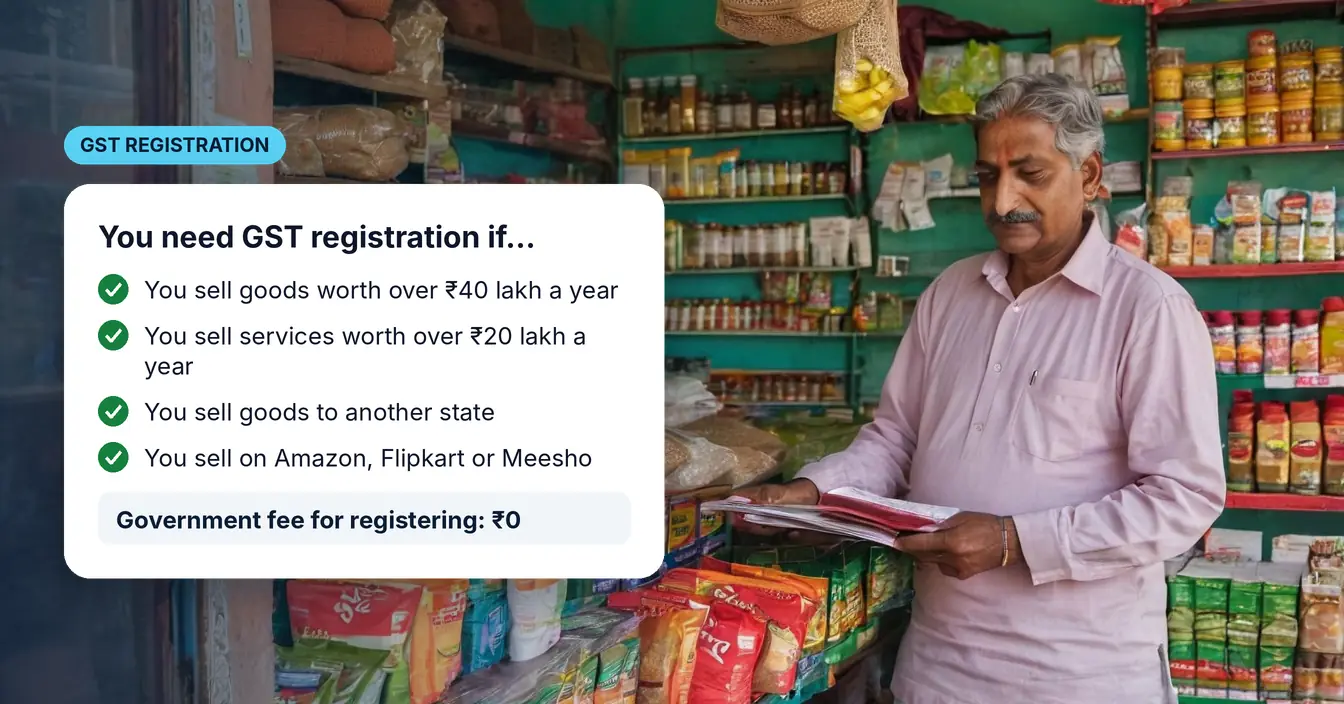
₹40 lakh for goods, ₹20 lakh for services, and the cases where turnover does not matter. Government fee: nil. Approval in 3–7 working days since Nov 2025.
Updated 6 October 2026
Most small businesses get one of two bad answers to this question. Either somebody tells them GST is compulsory for everyone and sells them a registration they did not need, or somebody tells them not to worry about it and they find out eighteen months later, with interest attached, that they were required to register from the first rupee.
The real answer is a short set of rules. They are worth knowing even if you pay someone else to handle it, because the person handling it is working from what you tell them.
Everything below is the position as at September 2026. Thresholds and procedure do change — the registration timelines in particular changed in November 2025 — so check anything you are relying on rather than trusting an article, this one included.
The turnover thresholds
Registration becomes compulsory once your aggregate turnover in a financial year crosses the limit for your state and your type of supply.
For most of India, including West Bengal:
- Goods — ₹40 lakh. If you sell goods and your turnover stays under this, registration is not compulsory on turnover grounds alone.
- Services — ₹20 lakh. Half the goods limit. This catches a lot of people, because a service business hits ₹20 lakh at a turnover a shop would consider small.
A set of special category states — largely the north-eastern states plus Jammu & Kashmir, Ladakh, Himachal Pradesh, Uttarakhand and Puducherry — run at half those figures again, ₹20 lakh and ₹10 lakh. If you trade from one of those, use the lower numbers.
Two details that catch people out:
Aggregate turnover is not the same as taxable turnover. It is all supplies made under the same PAN across all of India — taxable, exempt, exports, inter-state transfers, the lot. Someone whose taxable sales are ₹30 lakh and whose exempt sales are ₹15 lakh has crossed ₹40 lakh.
If you make both goods and services, the lower limit applies. A shop that sells items and also charges separately for repair or installation is not on the ₹40 lakh limit any more.
The cases where turnover does not matter
This is the part that generates the unpleasant surprises, because these categories must register from the very first rupee, whatever the turnover.
- Inter-state supply of goods. Selling to a customer in another state makes registration compulsory. There is a relaxation for inter-state services up to the ₹20 lakh limit, but for goods there is not.
- Selling through an e-commerce platform. Amazon, Flipkart, Meesho and the rest. There is now a narrow exemption for small suppliers selling within one state, but the general position is that registration is required.
- Being liable under reverse charge. Certain purchases make the buyer liable to pay the tax. If any apply to you, you must be registered.
- Casual and non-resident taxable persons. Trading at an exhibition or a seasonal stall in a state where you have no fixed place of business.
- Agents supplying on behalf of someone else, input service distributors, and anyone required to deduct TDS or collect TCS.
The one that most often goes unnoticed is the first. A trader who thinks of themselves as a local shop, but who ships to a customer in Bihar twice a month, is required to be registered.
Registering before you have to
Voluntary registration is a real option, and sometimes the right one.
The argument for it: you can claim input tax credit on what you buy, which is money back on stock, equipment and rent where GST was charged to you. And a great many business customers simply will not deal with an unregistered supplier, because buying from you means they cannot claim their own credit. In B2B, registration is often the price of being considered at all.
The argument against: registration is a door that only opens one way. From the moment you have it, you file returns every month or every quarter — including for periods where you traded nothing at all — and late fees accrue on nil returns exactly as they do on real ones.
So the question is not "can I register", it is "am I ready to file on a schedule, forever". If your customers are walk-in consumers and you buy little that carries input tax, voluntary registration usually costs you more in compliance than it returns in credit.
What it costs
Nothing. The government charges no fee for a GST registration.
This is worth saying plainly because a lot of money changes hands on the opposite assumption. There is a genuine cost to having someone do it properly — the application, the clarifications, the classification decisions, getting it right the first time — and that is a professional fee, which is a fair thing to pay. But if anyone presents a figure as a government fee for the registration itself, they are describing something that does not exist.
The same is true of Udyam, the MSME registration. The government's own portal says it in capitals: no fees for Udyam registration. Anyone charging you a government fee for that is charging you for a form that is free.
How long it takes
This changed in November 2025 and most of what you will read online is out of date.
Under the simplified scheme introduced then, if your projected monthly output tax liability is under ₹2.5 lakh and you complete Aadhaar authentication, registration is granted in three working days.
Outside that scheme, with Aadhaar authentication done and no physical verification required, the normal timeline is seven working days.
If the application is flagged for physical verification of the premises — which happens on risk criteria you do not get to see — it can take up to thirty days.
Two things make the difference between the fast path and the slow one, and both are within your control. Complete the Aadhaar authentication rather than skipping it, and make sure your address proof genuinely matches the address you are claiming. Most of the delays I see are one of those two.
One more deadline that arrives after approval and gets missed: you must furnish valid bank account details within thirty days of registration, or before filing your first return, whichever comes first.
The part nobody mentions until afterwards
Registration is the small half of the job. The filings are the large half, and they never stop.
Depending on your scheme you will be filing GSTR-1 and GSTR-3B monthly or quarterly, plus an annual return. Nil periods still require returns. Late fees run per day, per return, and they compound quietly — a business that stops filing for a year does not have one problem, it has twelve.
The reconciliation is the part that actually takes skill. Your input tax credit depends on what your suppliers have filed, not on what your invoices say. A supplier who has not filed leaves you unable to claim credit you have already paid for, and you will not discover it unless somebody is checking.
If you are working out what a price with tax on it actually contains, this calculator does the arithmetic on the current slabs:
GST — add it, or pull it back out
Slabs as they stand after the 22 September 2025 restructure. The old 12% and 28% general slabs are gone.
Within one state a supply is split evenly into CGST and SGST; across states it is a single IGST at the same total rate. Some specific goods still sit outside these four — precious metals at 3%, tobacco at 28% until it transitions — so check your own HSN code rather than assuming. This is arithmetic, not tax advice.
This calculator has its own page, if you want to send it to someone: Reverse GST calculator — and the slabs that actually apply
If you are already behind
This is more common than anyone admits and it is nearly always recoverable.
Late returns can generally still be filed. Late fees and interest accrue, and they grow with time, which is the entire reason the cheapest day to deal with it is today rather than after the next notice.
The first step is not to file anything. It is to establish what has actually been filed and what has not, from the portal itself rather than from memory — memory on this is wrong about half the time. Once the real position is on paper, the cost of fixing it is a known number instead of a fear, and it is usually smaller than the one people have been carrying around.
If a registration has already been cancelled by the department for non-filing, revocation is a defined process with a time limit attached to it. Missing that window makes a straightforward problem into a difficult one, so it is worth finding out where you stand before assuming the worst.
In short
- Under ₹40 lakh in goods, or ₹20 lakh in services, in a normal-category state: not compulsory on turnover alone.
- Selling inter-state, or through an e-commerce platform: compulsory from the first rupee.
- Both goods and services: the lower limit applies.
- The government's fee for registering is zero.
- Three working days under the simplified scheme, seven normally, up to thirty if physical verification is triggered.
- The filings are the real commitment, and they start the moment you are registered.
Everything here is general. What applies to a particular business depends on what it sells, where its customers are and what it buys, and getting that wrong is expensive in a way that getting it right is not. If you want it checked for your own business, GST registration and filing through SP Associates starts with exactly that question.
Written by Shyam Patra, who runs Orderzone from Kolkata. If something here is wrong or out of date, tell me and I will fix it — the date at the top changes when I do.